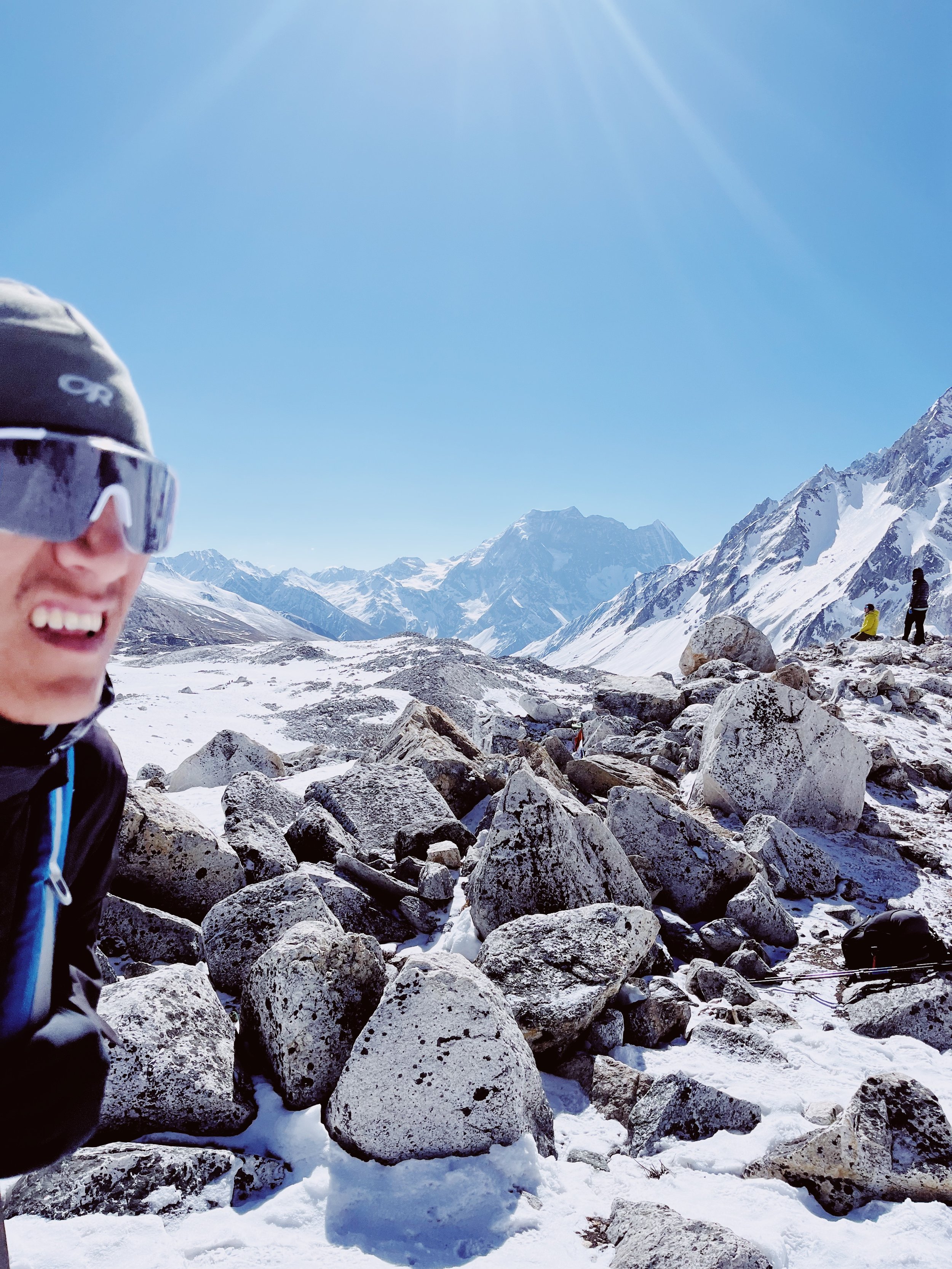
The High-Altitude State of Mind
A run in the Himalayas isn’t just a run.
There is a weird & wonderful thing that happens up there.
You can be exhausted, cold, breathless and surrounded by a landscape that makes your worldly problems feel minute.
And somehow, you can feel more awake.
I’ve spent many years going to the Himalayas to run, and have become increasingly interested in what is happening to the mind up there.There’s several changes…
First: awe
Psychologists have a name for the feeling that comes from encountering something so vast that it exceeds your normal mental frame of reference.
Awe.
A mountain range disappearing into cloud. An 8,000-metre peak appearing suddenly around a corner. The enormous silence of the Khumbu. A sky so clear at altitude that the stars seem almost reachable.
Awe isn't simply “wow, that's beautiful.”
It can change our relationship with ourselves.
One component of this as self-loss: a temporary reduction in the salience of the self. Another is connectedness - feeling more connected to the world around us.
In a 2026 study, researchers experimentally induced awe and found that it increased both of these experiences compared with a neutral condition.
Less preoccupation with yourself and more awareness of everything else.
That feeling is incredibly familiar in the Himalayas.
Then there is the oxygen
At 5,500 metres, the atmosphere contains the same percentage of oxygen as it does at sea level. But the air pressure is much lower, which means each breath delivers considerably less oxygen to your body.
Your physiology responds. Your breathing changes. Your heart works harder. Sleep changes. Exercise becomes harder. And at sufficiently high altitude, hypoxia can affect cognition and perception.
There is some fascinating research here:
A 1999 study interviewed eight elite climbers who had climbed above 8,500 metres without supplementary oxygen. The climbers reported a range of anomalous perceptual experiences, including visual and auditory phenomena and altered perceptions of their own bodies.
Another paper, written by researchers in cognitive neuroscience, explored an even more intriguing question:
Why have so many revelations throughout history happened on mountains?
The authors looked at similarities between mystical experiences described in religious traditions and unusual experiences reported by modern mountaineers. They proposed that altitude, hypoxia, isolation and changes in brain systems involved in body perception and self-awareness could contribute to some of these experiences.
It's a hypothesis, not an explanation, which is important to differentiate.
We shouldn't romanticise hypoxia. At extreme altitude, confusion and hallucinations can also be symptoms of serious altitude sickness.
But the broader question is compelling.
What happens when you change the conditions of consciousness?
This is the part I find really interesting.
We tend to think of the mind as something fixed that we carry around with us.
But when we change the conditions, it changes too.
Take away oxygen.
Add physical exhaustion.
Remove the constant noise of phones, traffic, emails and other people.
Spend hours moving rhythmically through an enormous landscape.
Sleep somewhere you've never slept before.
Look at a mountain that makes you feel very, very small.
Do this for two weeks.
You are no longer operating under the same conditions as you do at home.
Maybe that's part of the reason long mountain journeys can feel disproportionately significant.
You're not only travelling through a landscape, but you’re changing the environment in which your mind is operating.
The Himalayas amplify this
There are beautiful mountains everywhere.The Himalayas are of a different scale.
In the Khumbu, you can spend days moving between 3,500 and 6,000 metres, with the landscape continuously reminding you that you are somewhere physically extreme.
The villages are small. The peaks are enormous. The effort for the distances covered becomes difficult to comprehend.
You walk for hours towards a mountain that seems to remain exactly the same size.
Then you look back and realise you've crossed an entire valley.
There is something psychologically useful about that kind of scale.
Your ordinary concerns don't necessarily disappear, but they inhabit a different world that you have stepped out of.
And perhaps that is one definition of transcendence:
not becoming someone else,
but briefly getting some distance from the person you normally spend all day being.
So what is the “high”?
I don't think it's as simple as altitude.
And I don't think it's purely psychological either.
It's probably the interaction.
Hypoxia.
Exercise.
Exhaustion.
Awe.
Novelty.
Isolation.
Silence.
Scale.
Attention.
None of these things is considerably mysterious on its own.
Put them together, at 5,500 metres, and the experience becomes harder to explain.
That is what interests me.
Run High was never really about running from A to B.
It's about using running to enter places where the normal rules become less fixed — physically, psychologically and sometimes, if we're lucky, existentially.
The Himalayas happen to be one of the best places I know to do that.
And maybe the question isn't:
“Why does altitude make us feel different?”
Maybe it's:
“What becomes possible when we deliberately change the conditions under which we experience ourselves?”
That's something I want to keep exploring.
And, preferably, while running.
Read the research
Awe and self-transcendence
Zhao, Noordewier & van Elk, Effects of awe on self-transcendence: A registered report study (2026).
Mountains, altitude and mystical experience
Arzy et al., Why revelations have occurred on mountains? Linking mystical experiences and cognitive neuroscience (2005).
Perceptual experiences at extreme altitude
Brugger et al., Hallucinatory experiences in extreme-altitude climbers (1999).
Written by Kirra Balmanno